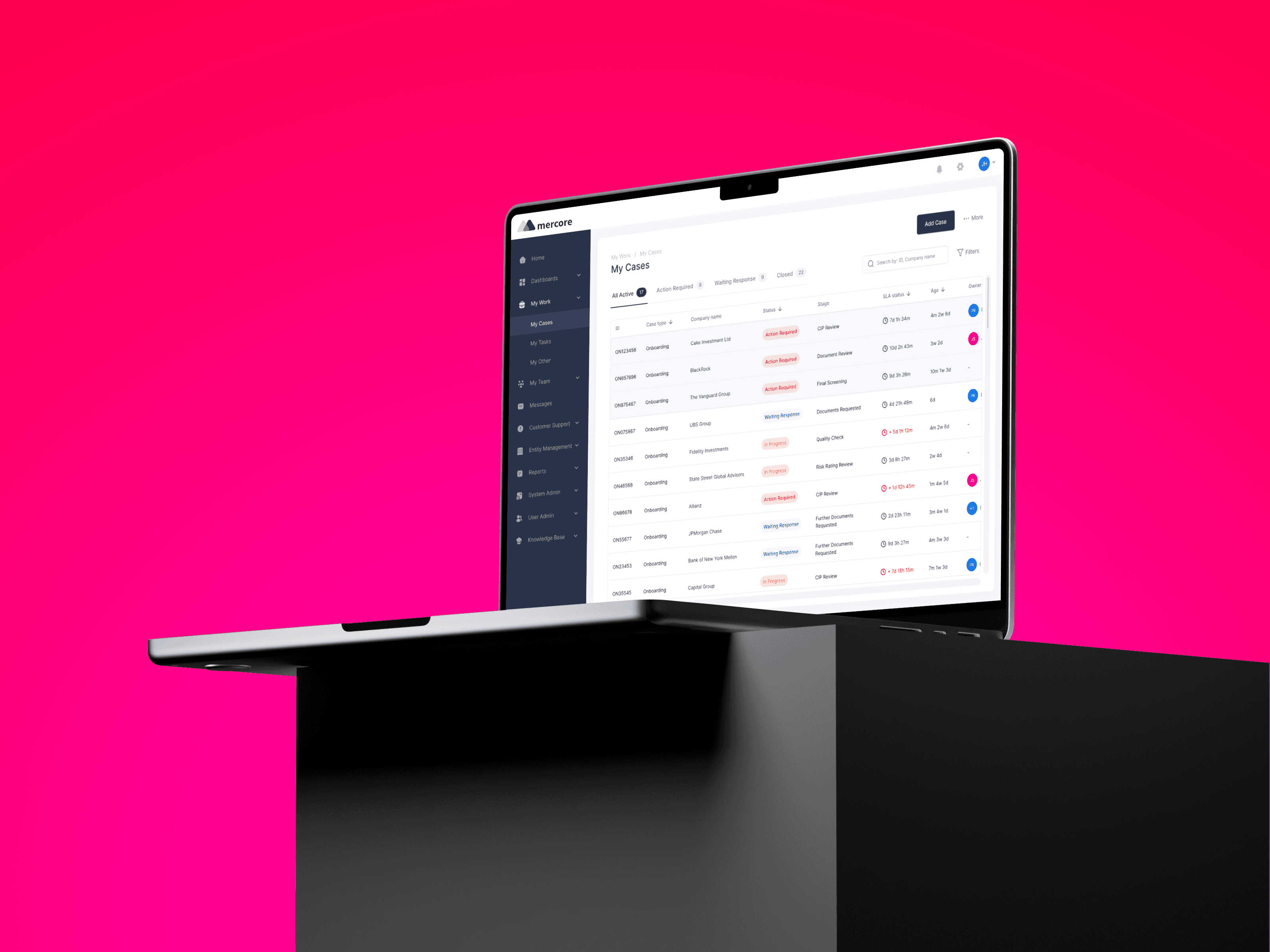
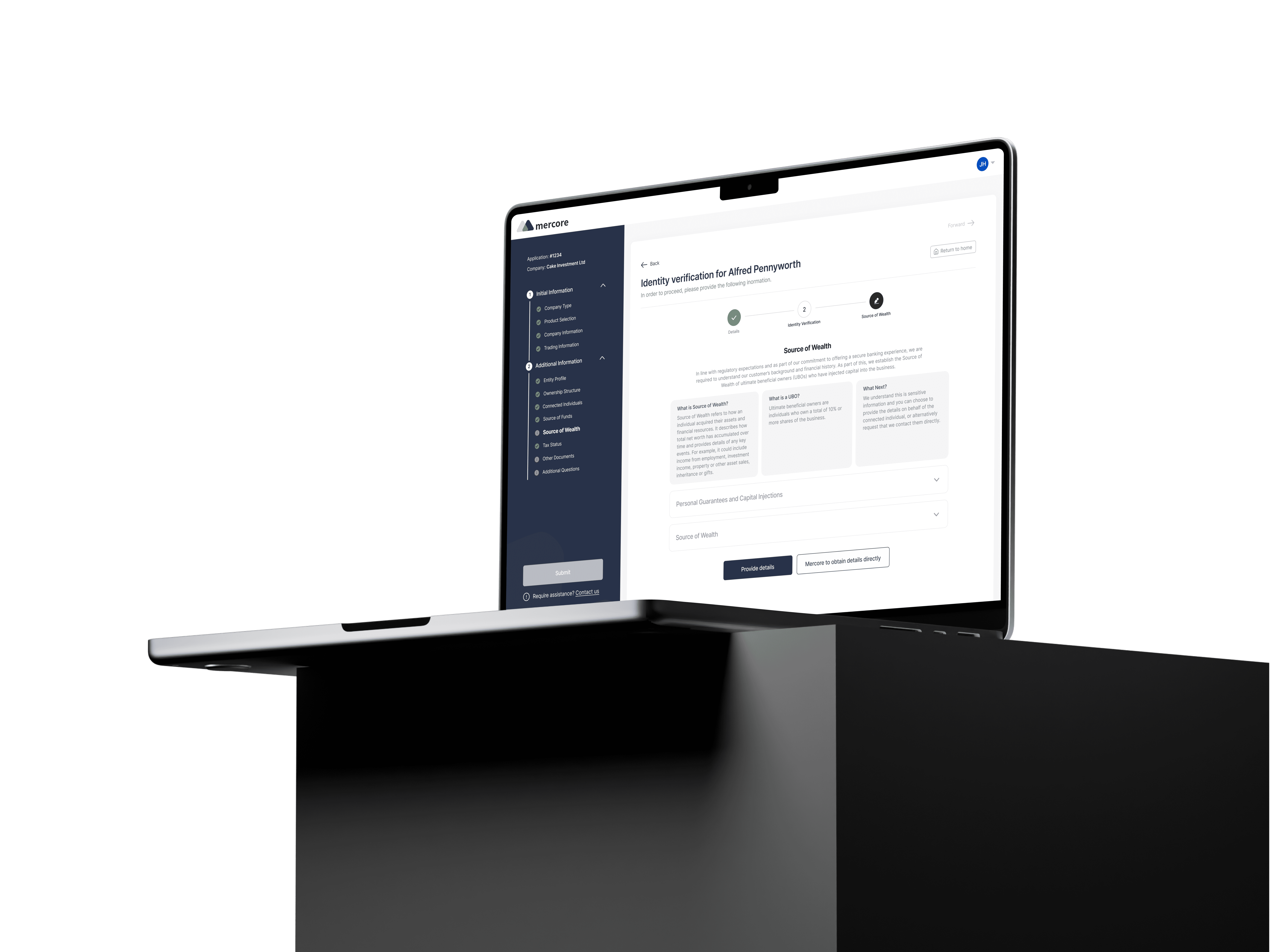
Mercore is a global fintech providing trade finance and transaction facilitation for businesses and individuals. Before any financing can be approved, Mercore must verify the identity, risk, and background of every participant involved. This is done through a series of compliance workflows that include Customer Due Diligence (CDD), Politically Exposed Person (PEP) checks, source of wealth (SoW) verification, and complex entity relationship mapping.
Project Results
Better compliance accuracy due to structured inputs
Faster onboarding for both individuals and companies
Faster design delivery because of reusable components
Duration:
2021 - 2023
2024 - 2025
Project Scope:
Design, prototyping, Design systems, Cross team collaboration
My Role
When I joined, most of the foundational UX was already present, but the product needed a more scalable, modern, and clarity-first UI. These flows are used by clients who might not be familiar with regulatory language, so the experience needed to feel trustworthy, secure, and simple. At the same time, compliance teams needed speed, accuracy, and predictable patterns. My role was to redesign and refine these workflows, strengthen UI consistency, and serve as a long-term design partner to Mercore through live collaboration, real-time iterations, and continuous improvements. I designed and optimised the CDD, PEP, SoW and Entity Management flows.
The Problem
Compliance design is unlike consumer design. Every field, interaction, and decision point carries legal and risk implications. Mercore’s workflows had a few challenges that needed to be addressed.
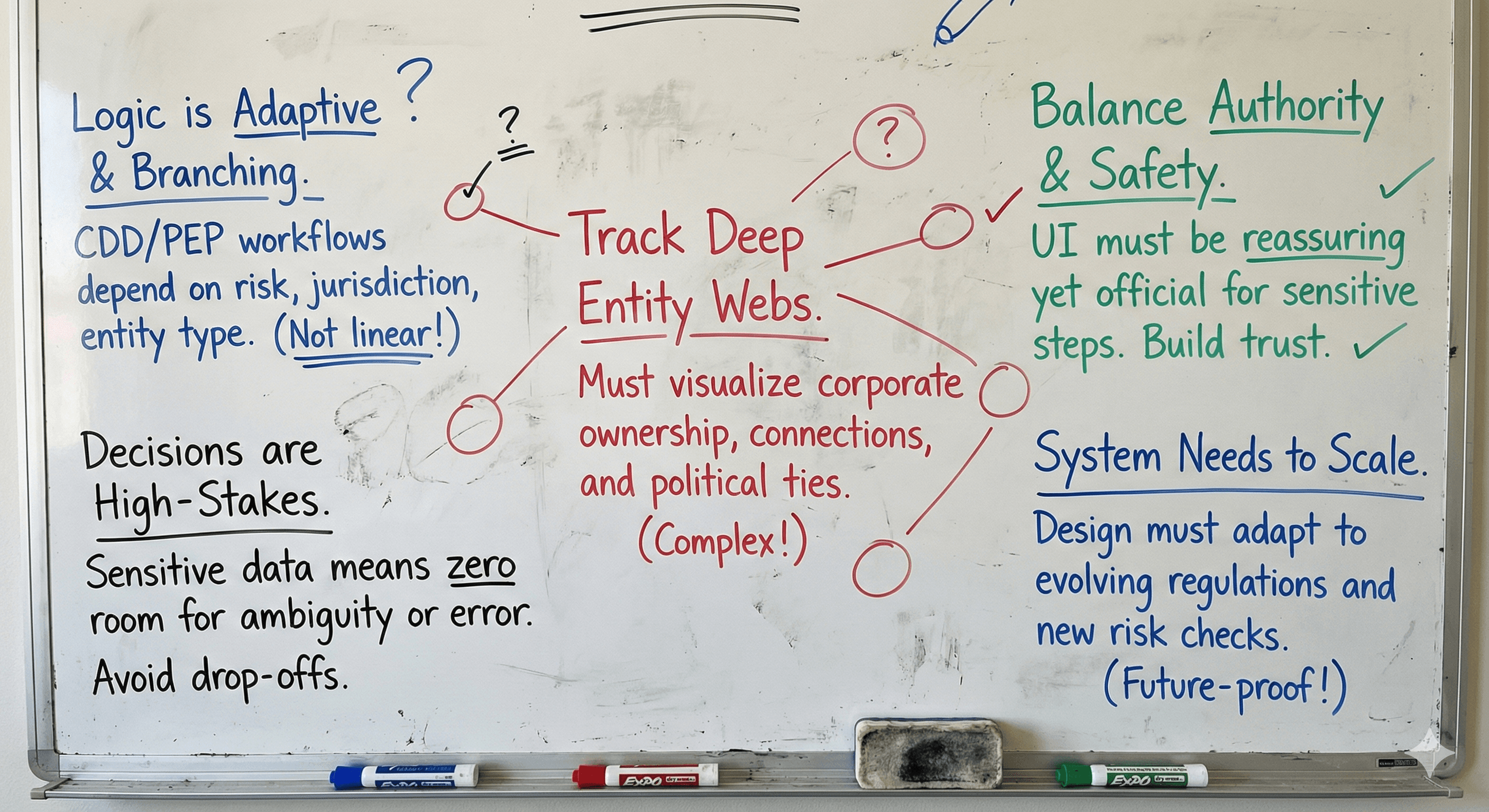
Complex branching logic
Flows like CDD and PEP behave differently depending on the user’s entity type, jurisdiction, or risk category.
High-stakes decisions
Users need to share sensitive financial and personal information. Misinterpretation or ambiguity could lead to drop-offs or incorrect submissions.
Deep entity relationships
For corporate clients, the platform has to track ownership, connected individuals, beneficial owners, and political exposure.
Trust and clarity
Scalability
Setting our course
Before redesigning anything, I sat with Mercore’s compliance and legal teams to understand how their workflows operate. I studied their regulations, old forms, and how risk is assigned. I also reviewed feedback from support teams about user confusion and slow onboarding for clients.
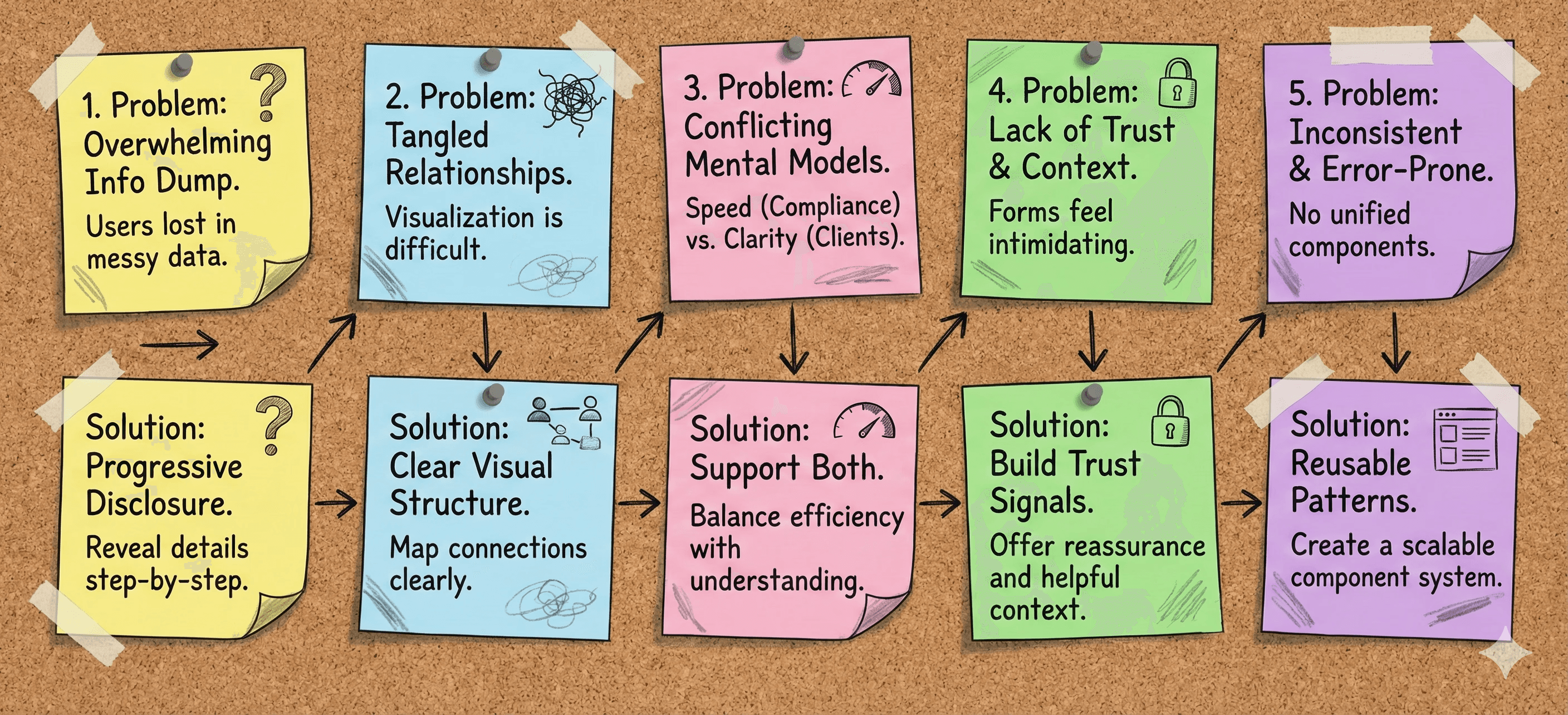
Users feel overwhelmed when they see everything at once
We needed progressive disclosure so users only see what is required at that step.
Relationship data is difficult to visualize
Connected Individuals needed a visual structure that explained relationships clearly.
Compliance and clients have different mental models
Compliance officers want speed. Clients want clarity. We had to support both.
Trust signals matter
Reusable patterns reduce errors
Mapping the Solution
Once the gap areas were clear, I began mapping the improved structure for each workflow. The goal was to break large processes into smaller, understandable steps.
1.
2.
Break down sensitive inputs into smaller, manageable sections.
3.
4.
Adapt flow branching automatically based on earlier answers.
5.
6.
This structure was applied to all major modules.
Design Process
My workflow with Mercore looked like an ongoing partnership rather than a single sprint.
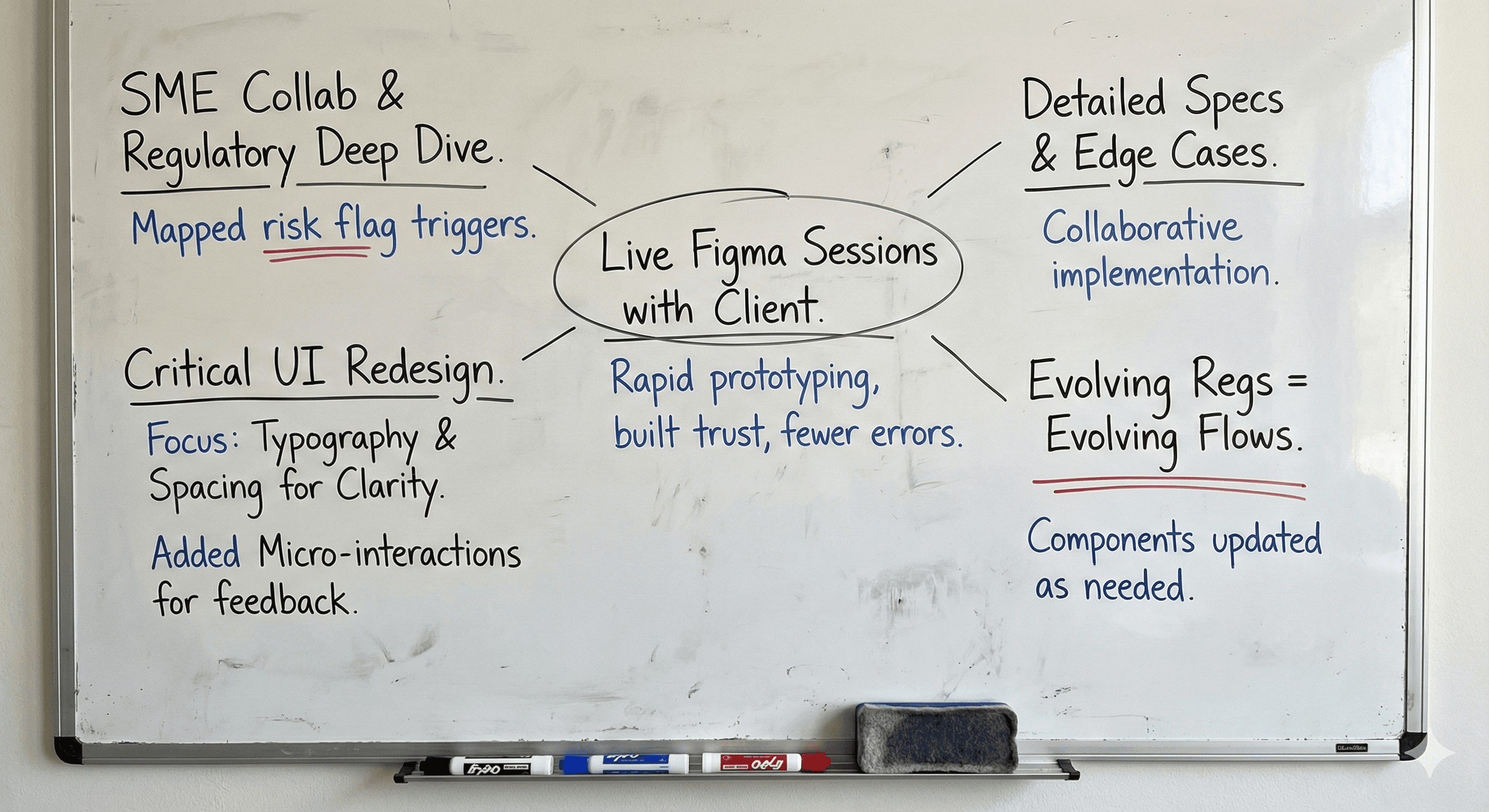
Research
Visual Design
Real-Time Co-Creation
Developer Handoff
Designing the CDD requests
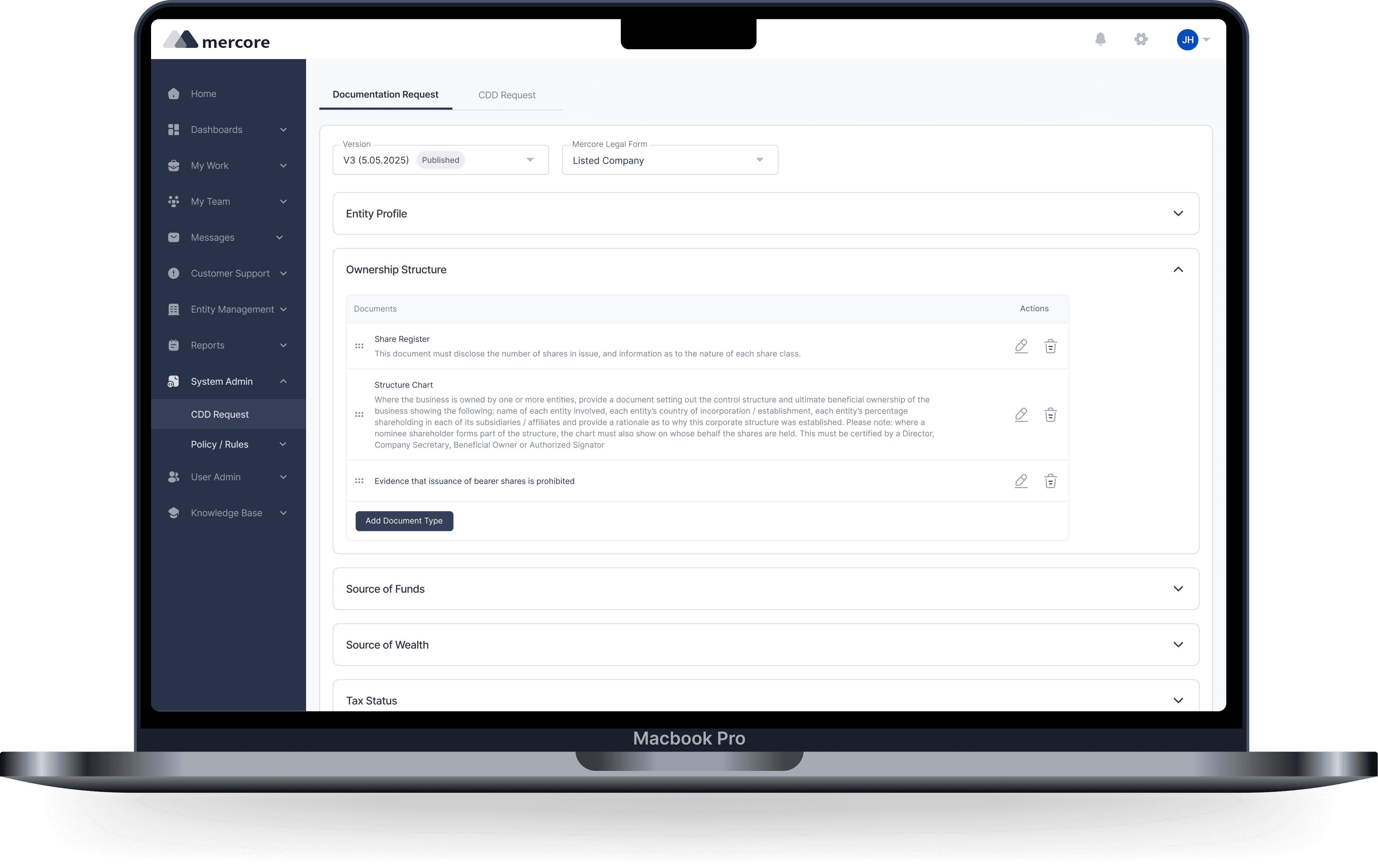
Customer Due Diligence (CDD) is where users share personal or company details, document proofs, ownership data, and risk identifiers for Mercore to verify. I designed the UI layout to accomodate for additional CDD requests if the initial requests fail or additional questions are to be asked.
Introduced Audit History
For a business that deals with complex financing, multi-step due diligence, and regulatory oversight across various jurisdictions, this wasn’t a nice-to-have. It was a critical gap. There needed to be a way to trace every action taken on an application, not only for operational clarity but for compliance, audits, and internal investigations.
Case Level Events
CIP (Customer Identification Programme) UpdatesDesign
Documents
Connected Individuals (CI)
Risk Ratings
Connected Individuals
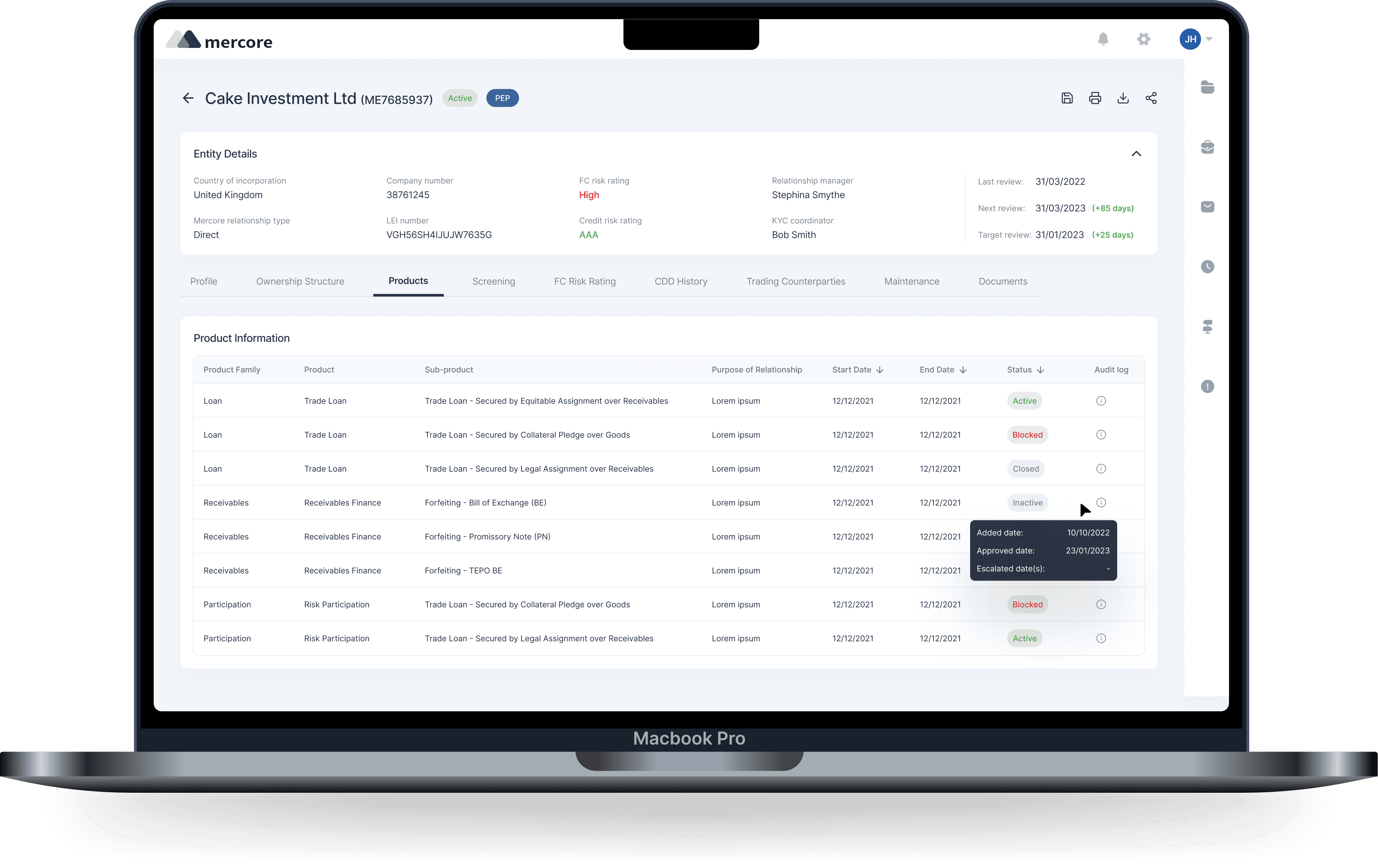
This module identifies who is connected to a company or individual. It might include directors, beneficiaries, trustees, or owners.I designed a relationship-tree pattern where users can add individuals, specify their roles, and visualize how everyone connects. This helped clarify ownership structures, which are often the most complex part of onboarding.
It was imperative to find if a CI is already a part of Mercore's database. They could be a director, UBO etc. to another client a well and Mercore would need additional information from them to differentiate.
Case 1: No match is found to the CIs
In this case, no match is found to the CIs are added for a case.
Case 2: Match found but rejected
In this case, match is found but are rejected.
Case 3: Match found and additional document requested
In this case, matches are found and one is accepted. Additional documents are requested.
Politically Exposed Persons (PEPs)
If a user or connected individual is politically exposed, additional checks apply. I built clear UI prompts that explain what PEP means, why extra checks are needed, and how risk levels will change.
PEP flows are connected to CI flows, as when CIs are added, they're needed to be categorised if they are PEPs or not as PEP introduce new checks and risks for Mercore.
Case 1: CI is already a PEP
In this case, the accepted match for a CI is already a PEP.
Case 2: CI is now a PEP
In this case, the accepted match for a CI was not a PEP when the CI was added, but is PEP now.
Case 3: PEP to be added
In this case, the CI which is a PEP, is to be added.
Source of Wealth (SoW)
Mercore is required to understand the customer’s background and financial history, in line with regulatory expectations and to offer a secure banking experience. As part of this, Mercore establishes the Source of Wealth of ultimate beneficial owners (UBOs) who have injected capital into the business.
Users feel overwhelmed when they see everything at once
Financial institutions are required to verify the legitimacy of funds used by UBOs. Designing a structured SoW flow ensures Mercore meets global AML and KYC regulations, reducing the risk of non-compliance, penalties, or failed audits.
Detecting Illicit or High-Risk Capital
A well-designed SoW process helps analysts identify abnormal, unverifiable, or suspicious sources of capital early in the review. This prevents onboarding of individuals or entities with questionable wealth origins.
Standardising the Verification Process
Before the new flow, analysts often collected SoW data inconsistently. The redesigned SoW module creates a uniform checklist, documentation flow, and evidence standards, ensuring all analysts work with the same criteria.
Improving Analyst Efficiency and Decision-Making
The SoW flow guides analysts step by step:collect → validate → document → assess.This reduces cognitive load, eliminates repetitive questioning, and enables faster, more confident approval or escalation decisions.
Building Trust With Partner Banks and Regulators
A solid SoW system strengthens Mercore’s credibility when partnering with banks, compliance auditors, and regulators. It demonstrates operational maturity and reinforces Mercore as a responsible lender that performs deep due diligence on all UBOs.
Learnings & Findings
Mercore helped me understand that designing for regulated fintech is about more than forms. It is about designing trust.
Simplicity
Reassurance
People need reassurance when dealing with compliance questions
Predictability
Live sessions
Live design reduces weeks of misalignment
Scalability
Even without hard numerical KPIs, we tracked qualitative improvements that mattered.
Next Project